
 EN
 ru
 pt
Application Advantages and Construction Specifications of D3 Grade Wood Glue in Outdoor Furniture Manufacturing
Nov 03, 2026D3 grade wood glue is the most practical EN 204 class for outdoor furniture joinery that faces intermittent water, humidity and condensation — think patio tables, garden benches, decks and exterior chair frames. In plain terms: D3 bonds well and stays strong through rain and morning dew, but it is not rated for permanent submersion or continuous ground contact. Whether the joint survives a wet season depends less on the glue and more on how you prepare the wood, control open time and clamping pressure, and stay inside its service limits. This article gives you both the application advantages and the construction specifications you can take straight to the workshop.
What EN 204 D3 actually guarantees
D3 is a water-resistance rating, not a waterproof claim. Under EN 204, a D3-classified adhesive must maintain its bond strength after withstanding intermittent exposure to water, high humidity and condensation. In outdoor furniture terms, that covers:
· rain running off a tabletop or seat slat
· overnight dew and morning condensation
· humid coastal or lakeside air
· occasional wet cleaning
What D3 does not cover: parts that sit permanently in water, pool constantly, or are buried in ground contact. Those belong to D4 . Getting this boundary right is the single most important decision in outdoor furniture bonding.
Application advantages for outdoor furniture
1. Water resistance matched to real outdoor use
Because it is a cross-linking polyvinyl acetate (PVA) water-based adhesive, D3 forms a bond that handles the intermittent wet-dry cycles an outdoor chair or table actually experiences, without the joint softening and creeping that a standard PVA (D1/D2) would show.
2. Bond strength that exceeds the wood itself
With shear strength above 10 N/mm² , the cured bond line is typically stronger than the surrounding wood. Under sustained load — a fully-laden patio table, a rocking garden chair — the failure point moves to the wood, not the glue line.
3. Low-VOC and formaldehyde-free
Non-toxic and formaldehyde-free, D3 is safer for the operators applying it in the factory and for the end user who brings the furniture home. This matters increasingly for furniture exported to markets with strict indoor-air and material compliance requirements.
4. Clean, machinable glue line
The adhesive cures to a translucent film that can be sawed, drilled, sanded and stained without gumming up abrasives — practical when you machine the joint after assembly rather than before.
5. Production-friendly working time
With an open time of roughly 15–30 minutes at 23 °C/50 % RH, you get a workable assembly window, and the water-based system is compatible with radio-frequency curing for faster pressing on high-volume lines.
6. Simple water cleanup
Before cure, tools and squeeze-out wash off with water — less downtime and solvent handling on the floor.
Construction specifications for a durable bond
Following these specifications is where the bond is won or lost.
Wood preparation
· Target a wood moisture content in the range of 8–12 % before gluing; work with freshly planed surfaces where possible.
· Remove dust, oil, release agents and loose fibers from both mating faces.
· A freshly planed or lightly roughened surface gives better mechanical keying than an over-sanded, burnished face.
· For joints assembled largely on end grain, add mechanical reinforcement (dowels, tenons, biscuits) — end-grain bonding alone relies heavily on the adhesive.
Application conditions and spread
· Apply at an ambient and material temperature of +5 °C to +35 °C; cold slows wetting, heat shortens open time.
· Spread adhesive onto both mating surfaces at a consumption of roughly 100–150 g/m².
· Bring parts together within the open time (15–30 min at 23 °C/50 % RH). A small squeeze-out along the joint line is the practical sign you applied enough.
Clamping
· Apply uniform clamping pressure of 1–2 kg/cm² — enough to close the joint and press out air, without starving the bond.
· Hold under clamp for 1–2 hours before release; extend this in cool or humid conditions and for thicker stock.
· Ensure even, gap-free contact across the full joint area.
Curing
· Full strength builds beyond clamp removal, so avoid loading the joint immediately.
· Where throughput matters, radio-frequency curing can shorten the pressing cycle on suitable lines.
Service limits in the field
· Keep D3-bonded parts out of permanent water and ground contact.
· Note the practical service temperature range (approx. −30 °C to +90 °C) when furniture moves between extreme climates.
· Design drainage and airflow so water does not pool on joints — a drip edge or a gap at a slat junction protects any adhesive, not just D3.
Cleanup and safety
· Wipe excess with water before it cures; remove cured residue by scraping.
· Work in a ventilated area and wear gloves to limit skin contact, as with any adhesive.
Storage
· Keep the container sealed at +5 °C to +25 °C; unopened, shelf life is 12 months. Discard any product that has gelled or thickened abnormally.
D3 or D4 — choosing correctly
If a joint will ever sit under water or in constant ground contact, choose D4. If it faces intermittent water and humidity — which covers most outdoor furniture — D3 is the cost-effective, sufficient choice, with a shorter pressing time and a water-washable, low-VOC system. Matching the class to the true exposure is both good engineering and good cost control.
Sourcing D3 wood glue at factory level
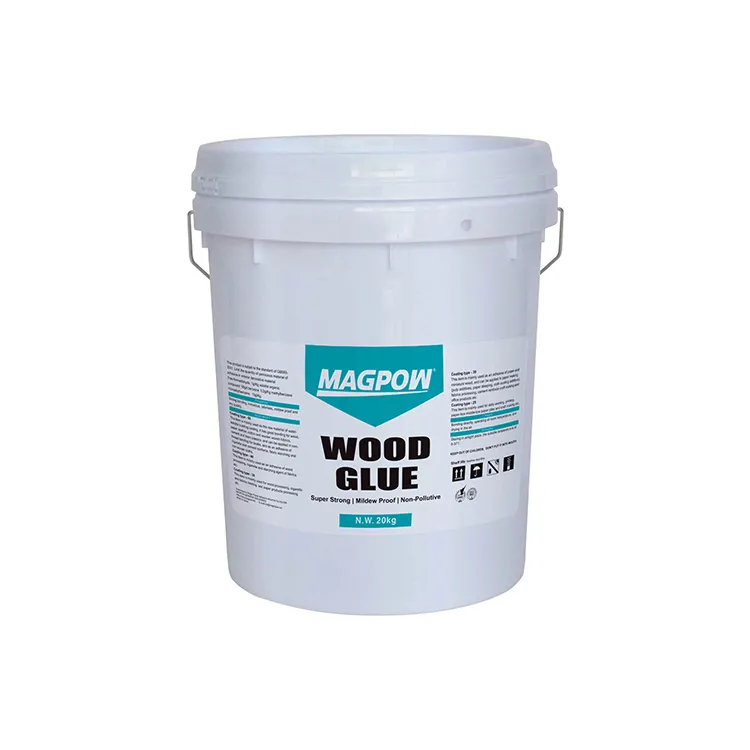
For furniture manufacturers and importers buying in volume, consistency of formulation and packaging matters as much as the spec sheet. MAGPOW, a China-based adhesive manufacturer with over 37 years in industrial adhesives and customers across 60 countries, supplies D3 wood glue factory-direct, including OEM/ODM and private-label programs — custom bottle design, branded logo printing, tailored carton artwork and export barcoding. Viscosity and open time can also be adjusted to regional climate conditions and automated gluing equipment, and export-grade cartons and buckets protect the product in ocean transit. For wholesale pricing, samples or custom partnerships, contact the MAGPOW export team.
Quick answers
Can D3 wood glue be used for outdoor furniture?
Yes, for parts exposed to intermittent water, humidity and condensation — most outdoor furniture qualifies. It is not for permanent submersion or ground contact.
Is D3 wood glue waterproof?
No. D3 is water-resistant under EN 204, not waterproof. True waterproofing is D4.
How long does D3 take to set?
Open time is about 15–30 minutes at 23 °C/50 % RH, with 1–2 hours under clamp before release.
At what temperature do you apply D3 wood glue?
Between +5 °C and +35 °C for both the adhesive and the workpiece.